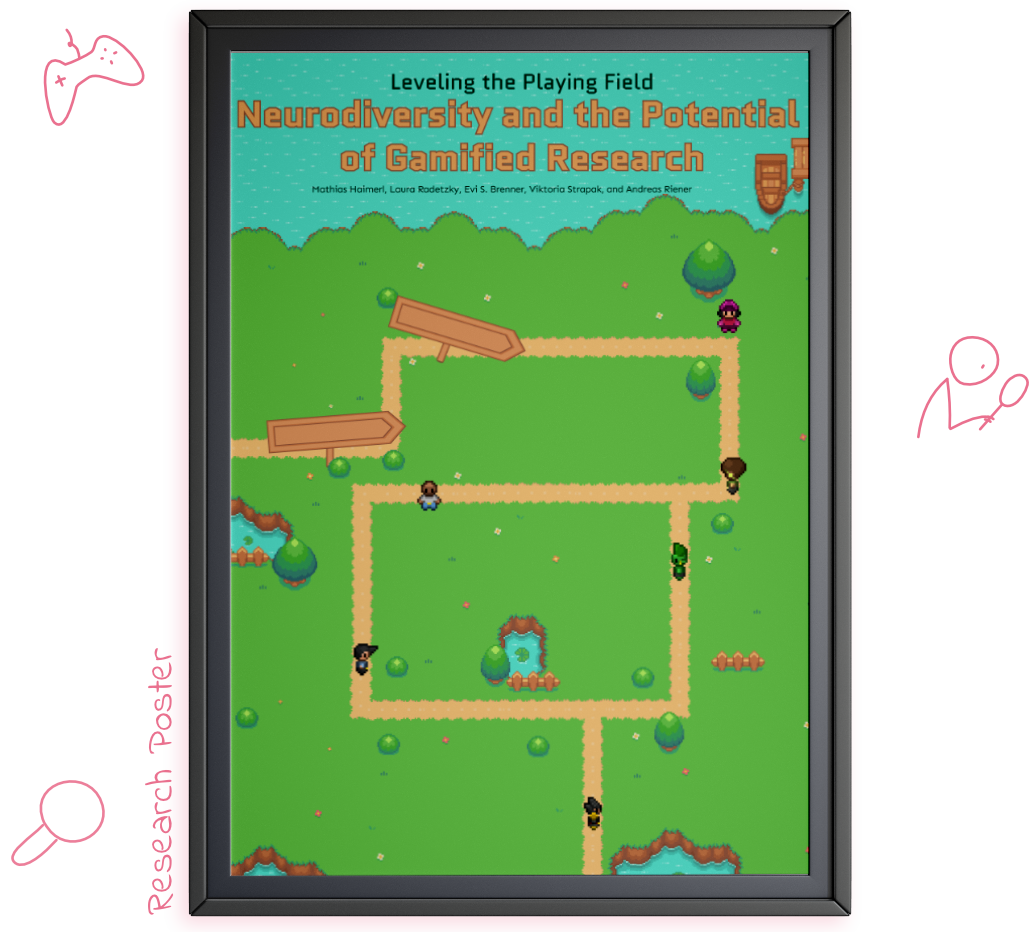
What if a questionnaire felt less like paperwork and more like a quest? We turned a standardized questionnaire into an RPG story line, then tested whether play could make research participation more welcoming for neurodivergent people.
Published at MuC 2025 · awarded best short paper
Contributions
❥ Visual and study design lead
❥ Creation of the narrative
❥ Development of the game in Unity
❥ Conduction of the study as a three-person research team
Outcome
❥ Preliminary study with 72 participants
❥ Best Short Paper at MuC 2025
The question
How can research be made more accessible?
Long questionnaires can be demanding for many participants, especially when questions repeat, instructions are dense, or earlier answers are hard to keep in mind. We wanted to explore whether a story-driven format could make participation feel clearer and more inviting without changing what the questionnaire measures.
01
Start with the participant
Research often requires participants to adapt to the method. We wanted to reverse that relationship.
Focusing on long instructions, repetitive questions, or reading long texts can be demanding, particularly for individuals with Attention Deficit Hyperactivity Disorder (ADHD), Autism Spectrum Disorder (ASD), or Dyslexia.
The challenge was not simply to make a survey entertaining. The experience had to reduce friction and support motivation while keeping the meaning of the Quality of Life Enjoyment and Satisfaction Questionnaire - Short Form (Q-LES-Q-SF) intact.
02
Turn repetition into purpose
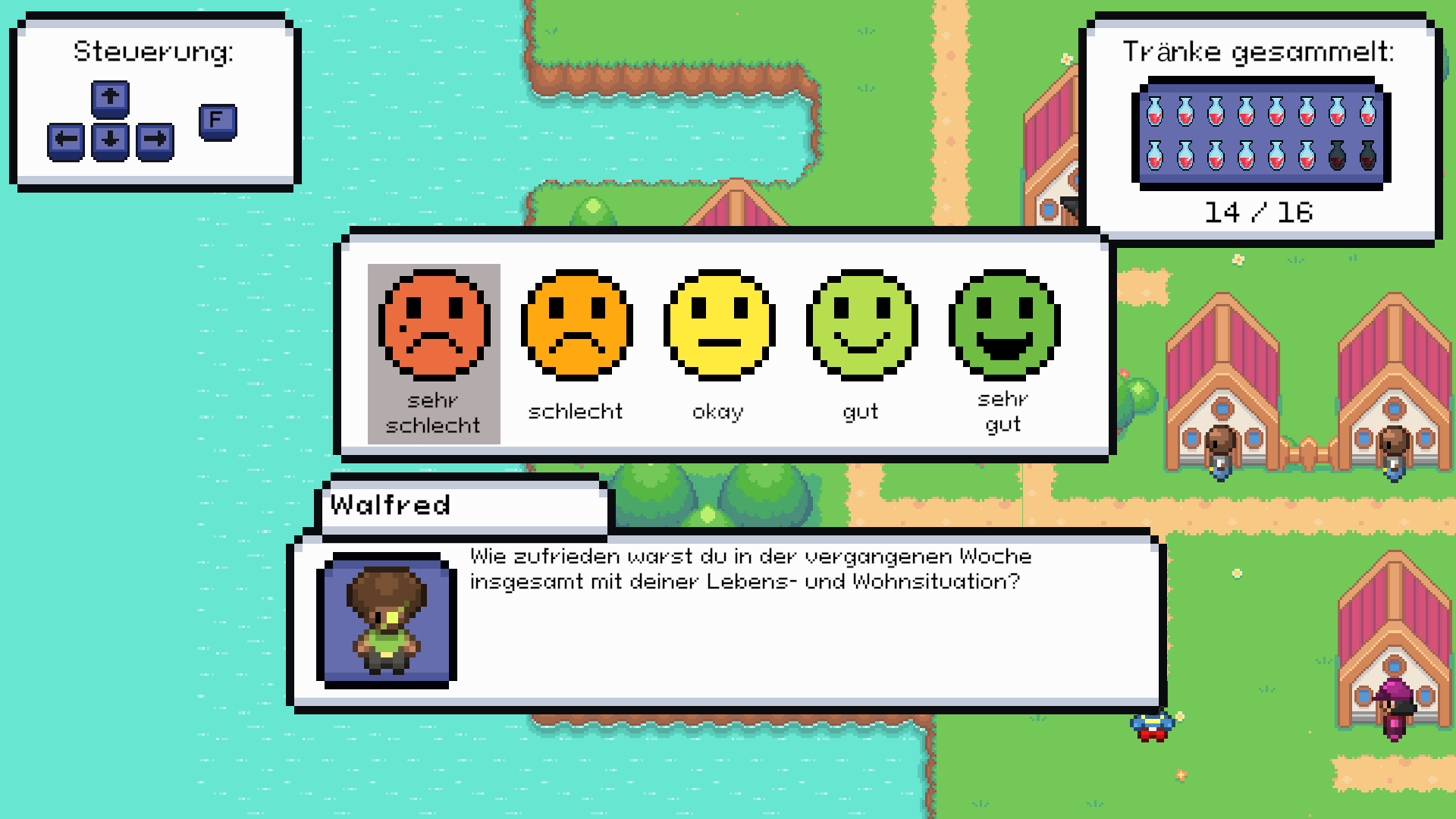
The 16 questions of the Q-LES-Q-SF were reframed into a short story line, with each item representing a quest from an NPC.
This allowed players to explore a retro-style town in a role-playing game, where they interacted with villagers and collected ingredients for a potion to cure their sick friend.
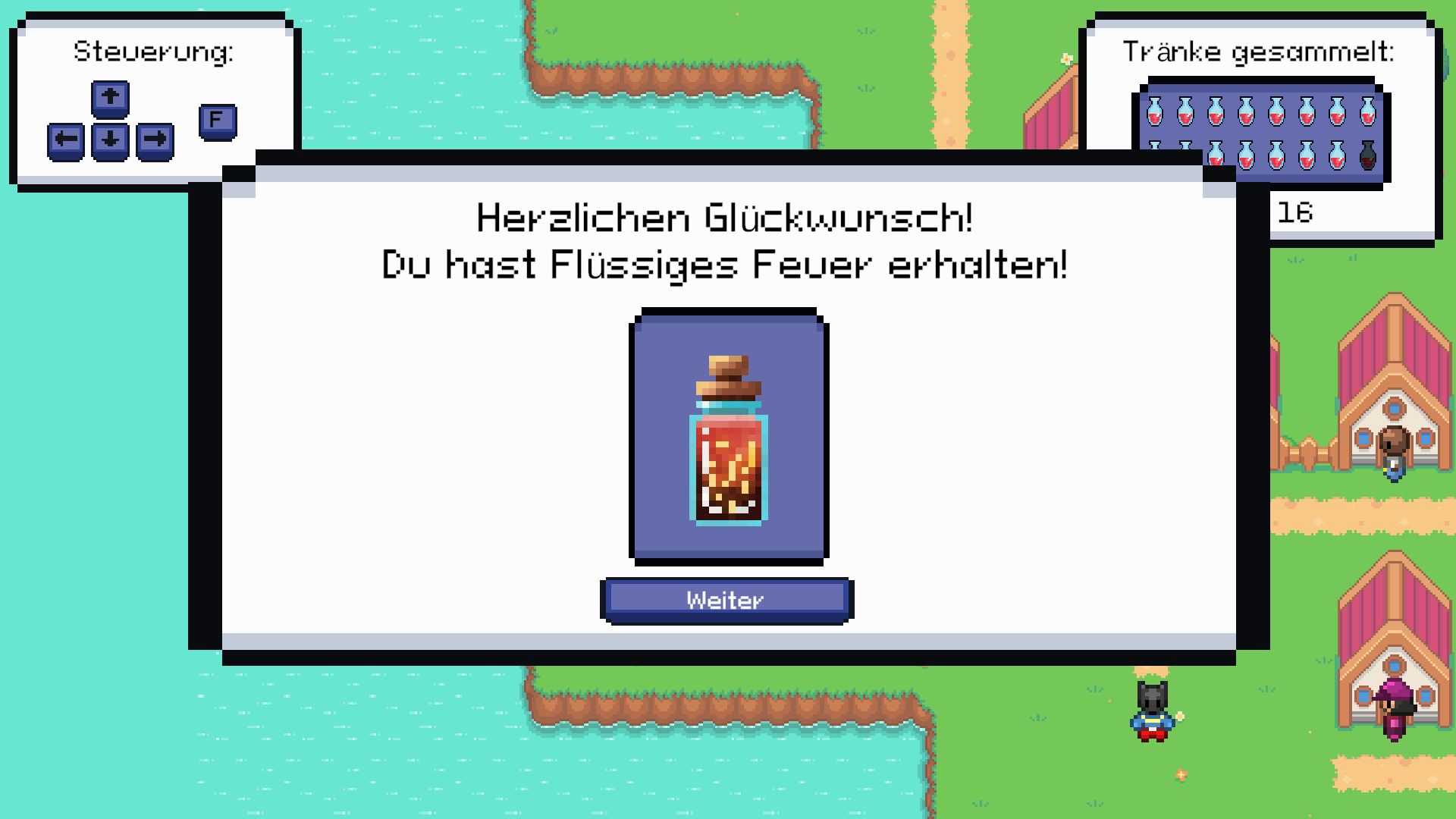
The story gave the quests a clear purpose: helping the sick friend. Fixed rewards and progress cues added context without rewarding particular answers.
Question as dialoguePlayers answer a Q-LES-Q-SF question using the emojis.
Quest rewardAfter completing the quest, the player is rewarded with a part of the final potion.
03
Keep play from changing the research
Gamification can introduce its own bias, so every playful choice needed a research guardrail. The story follows one linear path, rewards stay fixed, and players are reminded to answer truthfully. Onboarding explains both the controls and what participation involves.
This required a balance between having enough freedom to make the world enjoyable, but enough structure to keep each participant's journey comparable.
04
Running the study
We compared the two formats with 72 neurodivergent participants: 31 played the gamified version and 41 completed the conventional questionnaire. Afterward, everyone rated the experience and described moments that felt easy, confusing, or frustrating.
The comments were as valuable as the overall preference. Players surfaced practical issues around font size, sound, navigation, and knowing what would happen next. Those findings point to a clearer onboarding sequence, more accessible presentation settings, and fewer opportunities to get lost in a future iteration.
The outcome
Early results favored the gamified experience.
In this preliminary study, the gamified group rated the experience higher on the User Experience Questionnaire - Short (UEQ-S). Open responses also leaned more positive and engaged.
72 participants
One group completed a conventional questionnaire, the other a gamified version.
+0.323
Participants rated the playable version higher on average.
Future Explorations
Gamification can make participation feel more approachable and enjoyable, but it can also add novelty effects, new accessibility barriers, or pressure to behave in a certain way. A stronger follow-up should offer more presentation and control options, and test whether the playful format changes response quality or only enjoyment.